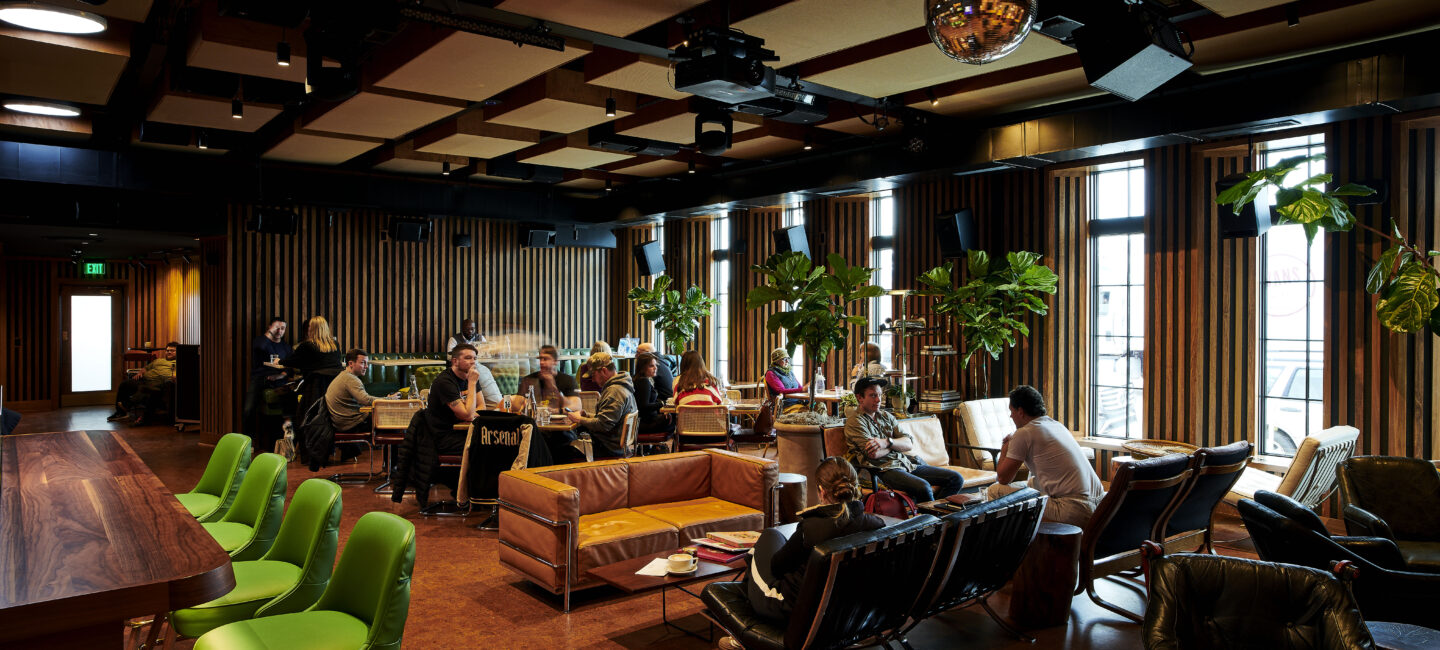
High Dive began with a question: how do you build a room engineered for serious listening that still feels like a living room, not a recording studio — and wrap it in a hospitality experience that works from breakfast through last call? The 4,044-square-foot bar and restaurant in Birmingham’s Lakeview district is the answer — a space that holds more than forty speakers and a full range of playback — reel-to-reel tape to high-resolution digital, two-channel stereo to full spatial audio, and live music — inside an envelope shaped by daylight, honest materials, and the small tactile pleasures of a classic bar: wood countertops, brass footrails, a back bar worth lingering over.
The discipline of the design is in keeping the engineering from living in the foreground. Walls thickened with hidden absorption read as stained wood slats and stretched fabric. Ceiling clouds doing serious acoustic work read as warm wood and fabric that nods to vintage speaker cabinets. The room geometry is tuned by fractions of a degree. The performance is technical; the experience is hospitable — an extended argument that audiophile-grade sound and a great place to spend an afternoon are not opposing goals.


A nearly eighty-year-old concrete masonry building in the Lakeview district anchors the east end of the block — a structure that has cycled through a long roster of local tenants, including a lamp store and a radio shop. It now serves as the cornerstone of the larger Lakeview Marina development, a music-focused group of parcels that includes a local record store in the northern retail space and an outdoor venue and food truck park adjacent to the project site.
A new addition extends the lounge off the existing structure. A recessed entry portal, carved at the seam between the existing building and the courtyard, draws patrons into the entrance while CMU breezeblock along one edge maintains a visual connection to the courtyard beyond.
The walls at the front of the lounge taper away from each other by a few degrees. Non-parallel surfaces disrupt the modal reflections that would otherwise stack between facing planes, a geometric correction that does the quiet double work of stretching the apparent length of the space.
In collaboration with acoustic engineers, specialized wall assemblies were developed to capture specific frequency ranges and minimize reflection back into the room. Helmoltz resonators integrated into the wall assemblies and a bass trap running the perimeter of the room at the ceiling work in conjunction to control low frequency sound waves. Coordinating with the audio engineer, an array of custom-built absorptive ceiling clouds were hung from the ceiling among the busy network of professional audio-visual devices.


AWARDS:
AIA Birmingham Distinction Award, 2026